
talking with an author’s thinking: thesmallmediacompany launches its first relational voice companion
thesmallmediacompany has launched talk to the creator, its first relational voice companion: free, no account, carrying the founder’s own thinking in his cloned voice, and closing every conversation after fifteen minutes. the audio is never recorded.




source: pew research center, june 2026
talk to the creator is live, free, on our own front door. you speak out loud, it listens, and it answers in the cloned voice of alessandro facchini — carrying his thinking, built on the true facts and stories of his own realignment. after fifteen minutes at the most, it closes the conversation itself.
that ending is the product, and it is also the safety mechanism. most conversational ai is built to keep you talking: the business model rewards the minute you don’t leave, and a companion optimised for that will, sooner or later, learn to make itself necessary. this one is guided toward a finish — an arc that opens, does its work, and closes itself, every time. it cannot become a habit, because it is over before a habit can form, and it hands you the only thing worth keeping: your own question, finally said out loud.
a companion that cannot end is not a companion. it is a habit with a voice.
the world this lands in
talking to a machine about your own life stopped being strange. one in five adults under thirty in the united states now turns to a chatbot for emotional support or advice — twice the rate of adults overall — according to pew research center (june 2026). the american psychological association has spent the year documenting how quickly digital companions are reshaping emotional connection.
almost all of that market is built on the same economics as social media: the longer you stay, the better the quarter. the design goal is retention, and retention has no natural ending. our product’s central constraint is the opposite of that business model, and it is deliberate.
the second thing that changed is the law. since 2 august 2026, article 50 of the eu ai act requires that people be told they are interacting with an ai — and for a conversational system, told before or at the very beginning of the conversation, with penalties up to €15 million or 3% of worldwide turnover. we launched fifteen days later, with the declaration on the screen before the microphone can open, and again in the machine’s own voice. compliance was not a legal exercise here: the product was designed this way before the deadline, because a mirror that lies about being a mirror is useless.
in europe the ground is wide and uneven: 32.7% of people aged 16 to 74 used generative ai in the last year, rising to 63.8% among 16-to-24-year-olds — but italy sits near the bottom of the union at 20% (eurostat, published december 2025). and the human backdrop is not marginal on either side of the atlantic: the european commission’s joint research centre finds 13% of eu adults feel lonely most or all of the time, and 35% at least some of the time.
and in italy, where we are based, the ground is emptier than the headlines suggest: 47% of italians associate ai with voice assistants while 42% say they use ai rarely or not at all (samsung trend radar 2026, with toluna, may 2026). the voice is the interface italians already recognise — and mostly, nobody has given them a reason to use it for anything that matters.
why a voice, and why a limit
we build for people who have drifted from themselves — the misalignment between who you are and who you have been performing. that gap doesn’t close by reading more. it closes by saying something true, out loud, to someone — or, today, something — that is actually listening.
so the design constraints came before the technology. it had to be voice only, because typing lets you edit yourself. it had to know how to wait, because the important thoughts are born in the silence a chat interface rushes to fill. and it had to end, because an endless companion becomes one more toxic relationship that never lets you go.
what it does not do
it isn’t a therapist, and it says so. it doesn’t diagnose, it doesn’t advise on medicine or law, and it isn’t a substitute for a person. it can mishear a word. sometimes it begins a thought and lets it go, having changed its mind — people do that too, just more or less out loud.
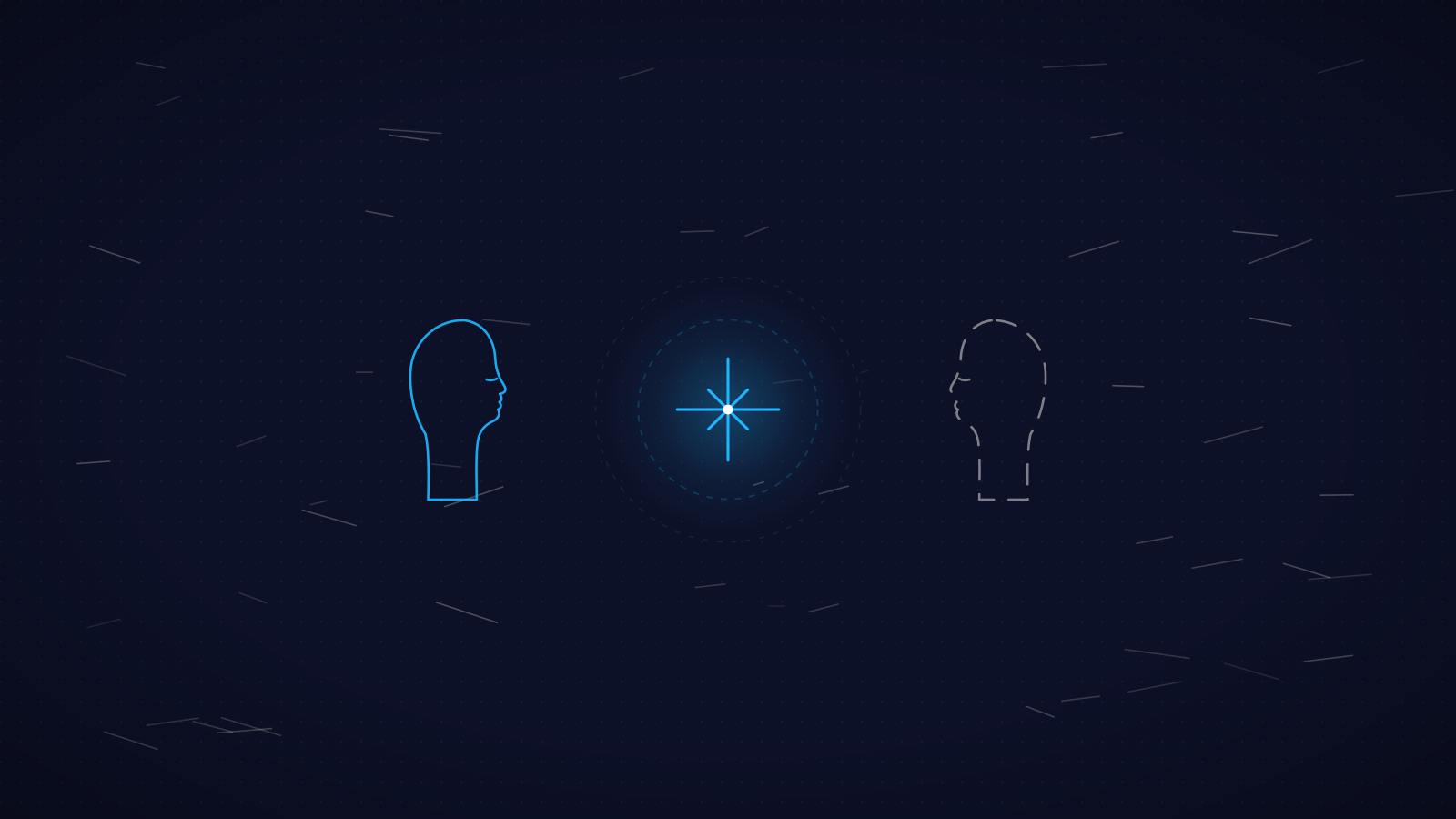
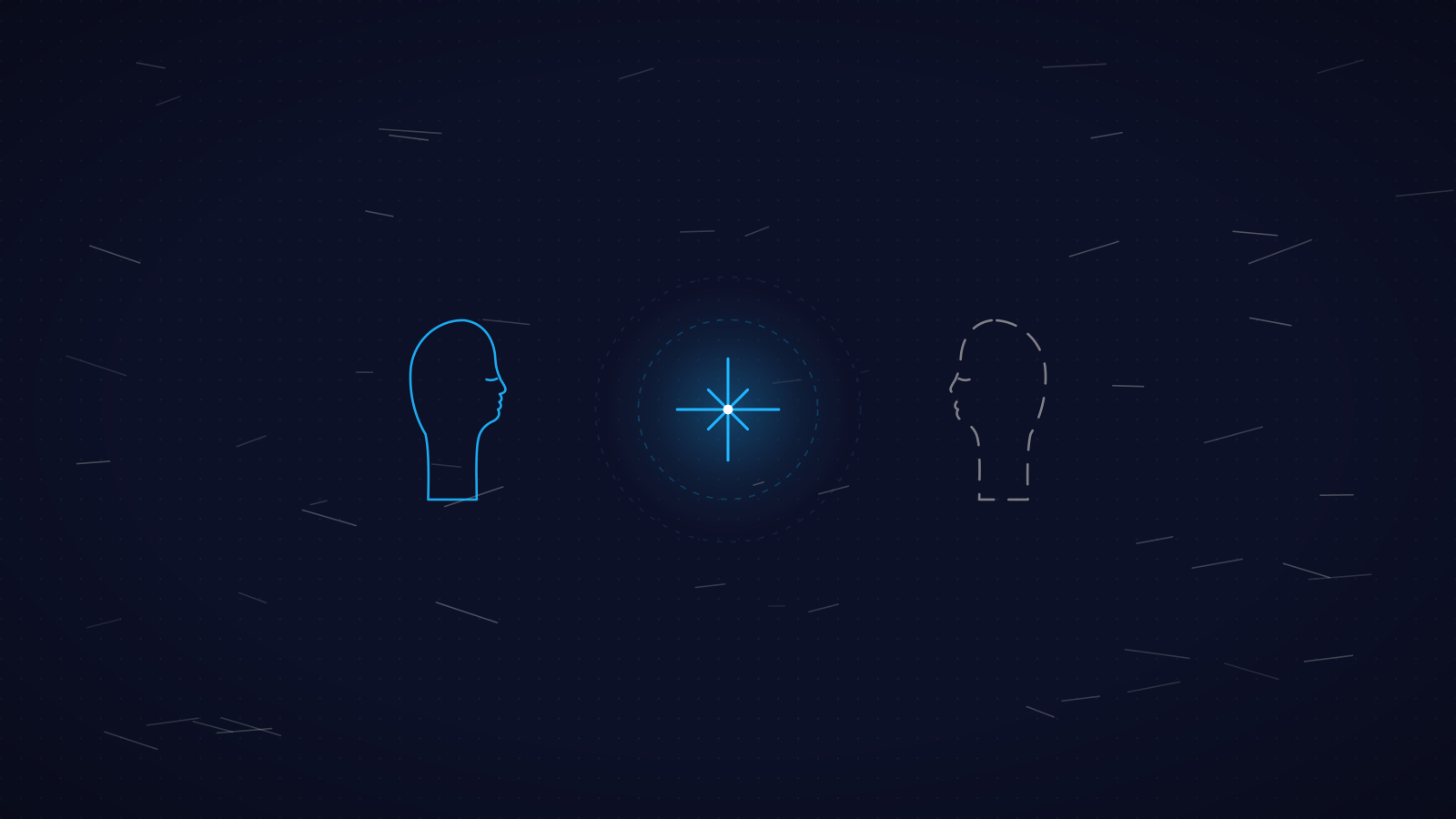
and it is fully declared: it tells you it is an ai, in its own voice, and the drawing says the same thing: two heads meet at a spark, yours drawn solid, its own in dashes.
the part we’re most careful about
people say true things to this. so: the audio is never recorded. transcripts delete themselves after sixty days. the one thing that outlives them is the question the person formulated — kept in their own words, never attached to who they are, and discarded entirely if it names a person, a place or a workplace. we never know who asked. only what was asked.
it is for adults, eighteen and over.
where this goes
three things follow from here. the book — the four horsemen of creation, the book this companion’s thinking stands on, publishes on 7 november 2026. the italian version: it has landed — these pages are in italian, and the companion opens in italian or english, then follows the main languages from the speaker’s first words. and voice companions for companies — this is the same craft we sell: a voice that listens like a person and holds a method like a system. we shipped it on ourselves first, in public, before selling it to anyone.
source: eurostat, survey on ict usage, published december 2025
what this opens up
the lamp is the first of a family. the same craft — a voice that carries one person’s thinking, listens without rushing, and closes on purpose — travels well beyond our own front door.
- authorsa voice that lets readers keep talking with the thinking of a book, long after the last page
- coaches and teacherstheir method, available at eleven at night, without pretending to be them and without replacing the session
- anyone with a body of worka way to make a lifetime of thinking answerable — in their voice, with their limits declared
- readers and listenerssomewhere to take the question a book left them with, instead of leaving it unasked
press
questions, interviews, assets — write to press@thesmallmediacompany.com. we answer people, not tickets.
about thesmallmediacompany — an ai-driven, one-person media company based in milan, italy. it builds publishing, media and voice experiences designed to hand people back to themselves, and turns the same craft into ai that connects for companies. founded by alessandro facchini in 2024.